Few safety features on modern vehicles get as much praise, or as much misunderstanding, as traction control. Some drivers believe it makes almost any road safe. Others switch it off as soon as they start a spirited drive. The truth sits somewhere between those views. Traction control is a useful safety aid, but it works within physical limits that no electronics can override. This guide explains what traction control is, how it detects and reduces wheel slip, how the main types differ, how cars and motorcycles compare, and where its benefits end.
What Is Traction Control and Why Does It Exist?
Traction control is an electronic system that helps a vehicle keep its driven wheels from spinning when they lose grip. Grip is the friction between a tyre and the road surface. When a driver accelerates too hard on a slippery surface, or powers out of a corner with too much throttle, the driven wheel can spin faster than the vehicle is actually moving. Once that happens, the vehicle may lose forward control, lose stability, or in a motorcycle’s case, risk the rear wheel sliding out from under the rider.
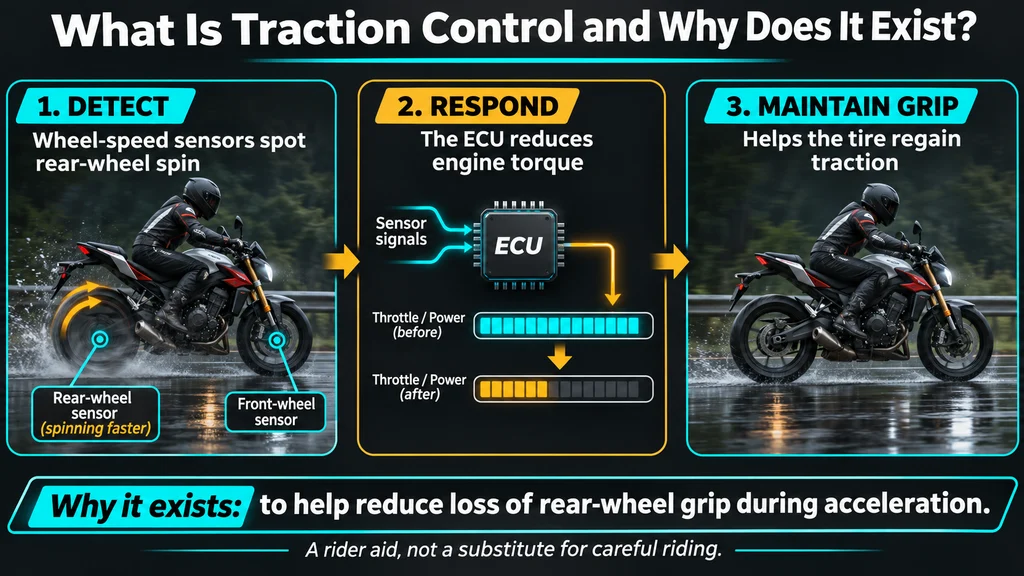
The system exists because human drivers cannot always judge grip accurately. Wet leaves, painted road markings, gravel, black ice, and changes in road camber can all reduce traction without warning. Traction control reacts faster than a human can, adjusting power delivery within milliseconds to help the tyres regain contact with the surface.
How Does the System Detect Wheel Slip?
Traction control depends on sensors that constantly compare how fast each wheel is turning. Most modern vehicles use wheel-speed sensors at each wheel, which are the same sensors used by anti-lock braking systems. The electronic control unit reads these signals many times per second and looks for a difference between the driven wheels and the non-driven wheels. If one driven wheel spins noticeably faster than the others, the system identifies that as wheel slip.
On a motorcycle, the detection process is more involved. A bike’s front wheel is usually free-rolling, so the system compares rear-wheel speed with front-wheel speed to identify slip. Many current motorcycles also use an inertial measurement unit, which measures lean angle, pitch, and acceleration. This data helps the system understand what the bike is doing in a corner, which is important because a bike’s wheel speed can change in ways that are normal during cornering. Without this context, the system could mistake a healthy turn for a loss of grip.
How Does Traction Control Reduce Slip?
Once the system detects slip, it acts to bring the wheel back into line with the vehicle’s speed. It does this in several ways, depending on the vehicle.
The most common method is adjusting engine power. The electronic control unit can reduce throttle opening, retard the ignition timing, or cut fuel to individual cylinders. Less power reaching the wheel means less torque working against the tyre’s grip, which allows the wheel to regain traction.
Braking is another method. In many cars, the system applies the brake to a spinning wheel. This slows that wheel and redirects engine torque to the wheel that has more grip. Motorcycle systems typically avoid direct braking in the same way, since braking during acceleration can upset the bike, so they rely more on engine management. Some newer systems combine both approaches, and some also work with the bike’s brakes in other ways, though this varies by manufacturer.
The interventions happen quickly and often without the rider noticing. A driver may feel a brief change in engine response, a slight pulse, or a warning light. The purpose is to keep the tyre within its grip range, not to stop the vehicle from accelerating altogether.
Types of Traction Control: From Basic to Advanced
Traction control systems differ widely in sophistication. Understanding the main types helps explain why two vehicles with the same label can behave quite differently.
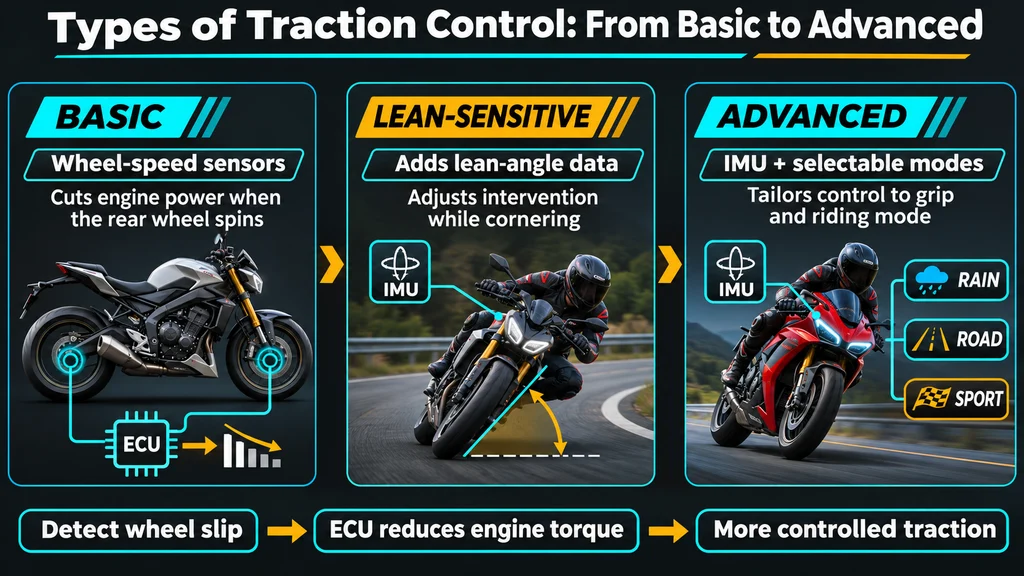
Basic systems
Typically work on a single level. They intervene when slip exceeds a set threshold and cut power in a simple, uniform way. These systems improve safety in many situations, but they offer little adjustment for the driver or the conditions.
Multi-level systems
Multi-level systems let the driver choose how much intervention they want. Settings often range from a less intrusive level that allows some wheel spin, to a fully active level that intervenes early. Many drivers use lower settings for track days or spirited riding and higher settings for wet or icy roads.
Mode-based systems
Mode-based systems go further by linking traction control to pre-programmed riding or driving modes. A rain mode might intervene earlier and more gently, while a sport mode might allow more slip for a sharper response. Some modes also adjust throttle mapping and power delivery at the same time.
Cornering-aware systems
Cornering-aware systems use additional sensors, especially inertial measurement units, to adjust intervention based on lean angle and the bike’s position in a corner. These systems are common on higher-end motorcycles, and they are designed to avoid cutting power at the wrong moment, which is a key factor in motorcycle safety.
Some vehicles also use stability control, which is a broader system. It can brake individual wheels to correct a skid or a loss of directional control, and it is closely related to traction control. The two systems often work together, but they are not the same thing.
Traction Control on Cars vs Motorcycles
Traction control has been standard on many cars for decades, and the principles are similar on motorcycles. The difference lies in how the vehicle behaves and how the system must respond.
Cars have four wheels in contact with the road, a relatively stable chassis, and a wide track width. Their traction control systems mainly manage wheel speed differences between the driven wheels, and they often use braking as a primary tool. Stability control adds the ability to correct sideways movement.
Motorcycles are less stable by nature. They balance on two contact patches, and their stability depends on lean angle, speed, and rider input. A motorcycle’s traction control must account for this. When a bike leans, its wheel speeds change in ways that do not indicate slip, and cutting power or braking at the wrong moment in a corner can upset the bike. This is why motorcycle systems rely on lean-angle sensors, careful engine management, and more refined intervention logic. Bikes also have less tyre contact area, so grip is more easily lost, which makes the system’s role especially important in wet or cold conditions.
Common Misconceptions About Traction Control
Several myths about traction control persist, and they can lead drivers and riders to make risky choices.
Myth: Traction control lets you drive faster on any surface. It does not. The system manages wheel slip, but it cannot create grip where none exists. A tyre on ice will still have very little friction, and the vehicle still needs a safe speed and gentle inputs.
Myth: Traction control means you can never lose control. This is not accurate. Traction control reduces some causes of loss of control, but it cannot prevent every skid, oversteer, understeer, or crash. Hazards such as sudden obstacles, poor visibility, and excessive speed can still lead to accidents.
Myth: You should always turn traction control off for better performance. Some experienced riders and drivers turn the system down or off on a track, where they want more control over wheel slip. For most everyday riding, however, leaving it on is the safer choice, especially in changing weather.
Myth: All traction control systems work the same way. As discussed above, systems vary greatly in design, sensors, and intervention logic. Checking the specific system in your vehicle’s handbook gives you more accurate information than assuming it behaves like another model’s.
Benefits of Traction Control
Traction control offers real safety benefits when it is used correctly. It helps reduce wheel spin during acceleration, which is especially useful when the surface is wet, icy, gravelly, or covered in loose material. It can help maintain stability in situations where the driver’s throttle input is a little too aggressive. It also gives less experienced drivers and riders a safety margin, since the system reacts faster than most people can.
These benefits are most valuable in conditions where grip changes unexpectedly. A sudden patch of oil or a wet painted line can break traction in an instant, and a well-tuned system can respond before the driver has time to react.
The Limits of Traction Control
Traction control is a helpful aid, but it has clear limits.
It cannot increase the amount of grip available between the tyres and the road. Tyre condition, tyre type, and tyre pressure have a major effect on grip, so worn or underinflated tyres reduce the system’s effectiveness. Road surface, temperature, and weather also play a role.
It does not replace good judgement. Entering a corner too fast, braking too late, or accelerating harshly in a bend can still create dangerous situations, and traction control may not be enough to prevent them. Motorcycles, in particular, depend heavily on rider skill, body position, and smooth inputs.
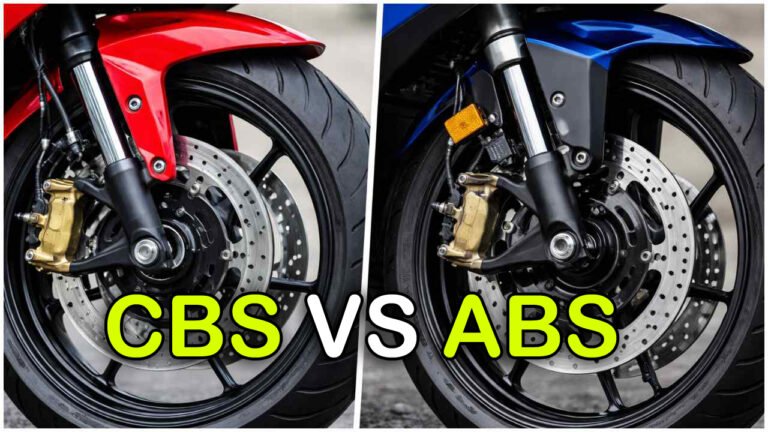
It does not cover every type of loss of control. Braking traction, where a wheel locks under braking, is handled by anti-lock braking systems rather than traction control. Some systems combine both, but they serve different purposes.
Finally, its performance depends on maintenance and calibration. Sensor faults, dirty wheel-speed sensors, and damaged wiring can reduce the system’s accuracy. If a warning light stays on, the system may be disabled, so the vehicle should be checked by a qualified technician.
Cars vs Motorcycles: Which Benefits More?
Traction control can make a meaningful difference in both, but motorcycles have more to gain in some situations. Because a bike’s stability depends on balance and grip at two contact patches, a loss of traction can happen more suddenly, and the consequences can be more serious for the rider. At the same time, motorcycle systems must work harder to avoid interfering with a healthy corner. The result is that the best motorcycle systems are often the most sophisticated, while the safety gain comes from sensible use, good tyres, and skilled riding.
Conclusion
Traction control is a valuable safety system, but it is not a substitute for good driving or riding habits. It helps the vehicle regain grip when the surface is slippery or when power is applied too aggressively. The benefits are real, especially in wet, icy, or loose conditions. Its limits are equally real: it cannot create grip, it cannot override physics, and it cannot make a risky decision safe. The best approach is to understand how your system works, keep your tyres in good condition, ride or drive within the conditions, and treat traction control as the safety net it is designed to be.
Frequently Asked Questions
Does traction control make driving safer?
In many conditions, yes. It helps reduce wheel spin and maintain stability, particularly on wet, icy, or loose surfaces. It is most effective as one part of safe driving, alongside appropriate speed, good tyres, and attentive control.
Can traction control prevent all accidents?
No. It cannot prevent accidents caused by excessive speed, poor judgement, obstacles, or limited visibility, and it cannot create grip that the tyres do not have.
Should I turn traction control off?
For everyday use, leaving it on is generally the safer choice. Some experienced drivers and riders adjust or disable it on a track, where they want more direct control. Check your vehicle’s manual before changing settings.
What is the difference between traction control and ABS?
Traction control manages wheel spin during acceleration. Anti-lock braking systems prevent wheels from locking under braking. The two systems often share sensors but solve different problems.
Is traction control the same as stability control?
No. Traction control focuses on wheel spin during acceleration, while stability control helps correct sideways movement and loss of directional control, often by braking individual wheels.Do motorcycles have traction control?
Many modern motorcycles do, and higher-end models often include cornering-aware systems that use lean-angle sensors. Availability varies by model and manufacturer